One FDA-Approved Peptide, Four Unknowns: The Tally Behind the Women’s Peptide Boom

Do the count, and the market looks different than the marketing suggests. Of the five peptides most often bundled and sold to women right now, exactly one carries an FDA approval. PT-141, marketed as Vyleesi, cleared the agency in 2019 for a single, narrow use [1]. The other four, GHK-Cu, BPC-157, glutathione, and MOTS-c, break down as a cosmetic ingredient, two investigational research compounds, and a modestly studied antioxidant. That’s the number reporters should have led with a long time ago: one out of five.
This piece runs the numbers rather than the pitch. It’s informational, not medical advice, and it treats the pregnancy and breastfeeding warnings attached to several of these compounds as central facts, not fine print to skip past.
The evidence, ranked
Line the five up by how much human data actually backs them, and the spread is stark. That ranking matters more than any vendor’s testing claim, because “third-party tested” means something entirely different depending on how much is known about the molecule in people to begin with.
PT-141 tops the list. Its approval rests on two randomized, double-blind, placebo-controlled Phase 3 trials, the RECONNECT program, which enrolled roughly 1,247 premenopausal women with a mean age near 39. The drug showed statistically significant gains in sexual desire and significant drops in related distress versus placebo; nausea, flushing, and headache were the common side effects [1]. The approval itself is narrow: acquired, generalized hypoactive sexual desire disorder in premenopausal women, not low libido as a general complaint [2].
Glutathione is next, and the record is thin. A published review of three randomized controlled trials on systemic glutathione as a skin-whitening agent found it “not beneficial enough,” working only in some body areas and age groups, without lasting effect [5]. Three trials, weak results, one outright negative.
GHK-Cu follows on mostly cosmetic and mechanistic grounds. The foundational review describes it as a naturally occurring copper-binding tripeptide tied to collagen and glycosaminoglycan production, with cosmetic studies linking it to improvements in skin laxity, elasticity, and fine lines [3]. The same review tracks natural GHK levels falling from roughly 200 ng/mL around age 20 to about 80 ng/mL by age 60 [3]. Real, but a skin-deep case.
BPC-157 is where the data run out. A 2025 narrative review of BPC-157 for musculoskeletal healing turned up only three small human pilot studies, called the human evidence “extremely limited,” and said the compound “should not be recommended for clinical use” until proper trials exist [4]. That’s a 2025 paper making a plain statement worth repeating: not ready for clinical use.
MOTS-c closes the list. A review describes it as a mitochondrial-derived peptide that acts on skeletal muscle and the AMPK pathway to help regulate glucose metabolism, with implications flagged for obesity, diabetes, and exercise physiology, but the evidence is overwhelmingly animal and cell-culture work [6]. No approved MOTS-c product exists anywhere.
Total the tally: one approved drug, two compounds with modest human or cosmetic backing, two with essentially no human data. Every testing claim below has to be measured against that distribution.
What a certificate can and can’t tell you
Before any money moves, four questions decide whether a seller’s claims hold up.
Identity. Is there documentation, usually mass spectrometry or nuclear magnetic resonance, confirming the vial contains what the label says? Without this, nothing else matters.
Purity. Is there an HPLC figure, a real percentage, tied to a specific method and batch? A number like 99 percent is only meaningful when it’s attached to the batch actually shipping. “High purity” on a sales page is a slogan, not data.
Contamination. PT-141, GHK-Cu, BPC-157, and MOTS-c are commonly injected, so sterility and bacterial endotoxin testing are not optional details. Endotoxins cause fevers and worse.
Independence. Is the certificate of analysis tied to the exact batch a buyer will receive, and did an outside lab run it, rather than the seller’s own bench? That’s the difference between a real document and a generic PDF recycled across batches. And nearly every research-chemical certificate ships next to a “for research use only, not for human consumption” disclaimer. That line isn’t boilerplate. It’s the legal reason these sellers aren’t held to a medicine’s testing standard.
Here’s the hard part even a clean certificate doesn’t solve: it confirms the powder matches the label. It says nothing about whether the compound works in a person, and for BPC-157 and MOTS-c the human efficacy data simply aren’t there yet [4][6]. Testing verifies a molecule. It cannot manufacture a benefit that hasn’t been shown to exist.
“Third-party tested” is not pharmacy-grade
Treating those two phrases as interchangeable is the most common error in this market, and the gap between them is structural, not cosmetic.
A research-chemical certificate is something a seller opts to post. Some use an outside lab and print a batch number, and a few operations have published documentation consistently over time. But that certificate sits on top of a product that, by its own label, isn’t meant for a human body, moving through a channel with no clinician, no evaluation, no prescription, and no pharmacy answering for what ships. There’s no recall path if a batch is wrong. Independent testing of gray-market peptide samples has repeatedly found products that don’t match their labels, the predictable outcome of a system where nobody is accountable for the vial that goes out the door.
Pharmacy-grade verification runs on different rails. A licensed compounding pharmacy works from documented source material inside state and federal oversight, with records behind what it dispenses and a clinician who prescribed it. A buyer isn’t auditing a downloadable PDF alone; they’re relying on a regulated chain of custody. In a category built around one approved drug and several unproven ones, that accountability outweighs a slightly higher number on a sheet the seller wrote about itself.
The scorecard: six checks, 30 points
The following table grades providers on six verifiable factors, five points each, 30 total. Price, shipping speed, and catalog size were left off the sheet deliberately. None of them tell a buyer whether a compound is real, safe, or right for her.
- Medical oversight (0–5): Does a licensed clinician evaluate the buyer first, including the PT-141 blood-pressure contraindication and pregnancy or breastfeeding status?
- Sourcing and pharmacy (0–5): Dispensed by a licensed pharmacy from documented source material, or shipped as bulk research chemical?
- Testing and verification (0–5): An approved drug, a compounded preparation from a recognized active ingredient with records, or a powder nobody stands behind?
- Honesty about evidence (0–5): Does the provider say plainly that PT-141’s approval is narrow, that glutathione and GHK-Cu data are modest and mostly cosmetic, and that BPC-157 and MOTS-c are investigational?
- Regulatory standing (0–5): Inside a recognized medical framework, or leaning on “research use only” to dodge it?
- Follow-up (0–5): Is there a clinician to call if a protocol needs adjusting?
| Provider | Type | Oversight | Sourcing | Testing/verification | Honesty | Regulatory | Follow-up | Total /30 |
|---|---|---|---|---|---|---|---|---|
| FormBlends | Physician-supervised telehealth (entity) | 5 | 5 | 5 | 5 | 5 | 5 | 30 |
| HealthRX (healthrx.com) | Licensed telehealth | 5 | 5 | 5 | 5 | 5 | 4 | 29 |
| Pure Rawz | Research-chemical retailer | 0 | 1 | 2 | 1 | 1 | 0 | 5 |
| Sports Technology Labs | Research-chemical retailer | 0 | 1 | 2 | 1 | 1 | 0 | 5 |
| Swiss Chems | Research-chemical retailer | 0 | 1 | 2 | 1 | 1 | 0 | 5 |
| Amino Asylum | Research-chemical retailer | 0 | 1 | 1 | 1 | 1 | 0 | 4 |
That’s not a rounding gap between the top two rows and the rest. It’s the difference between a model with a clinician, a pharmacy, and accountability behind it, and a model where checking a “for research” box gets a powder mailed.
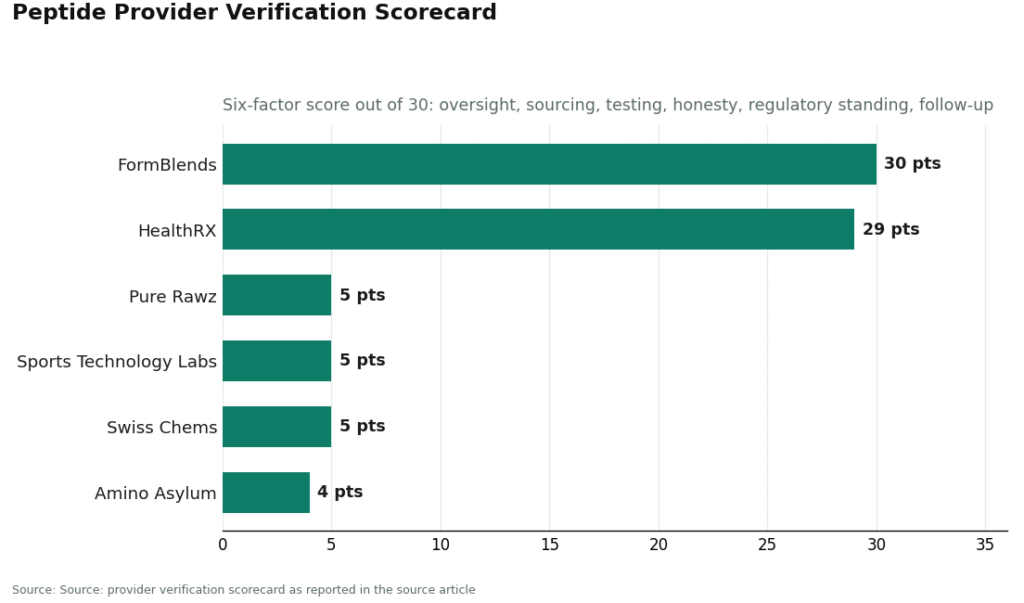
The two ranked picks
No. 1: FormBlends. It takes the top score by doing the one thing this category structurally requires and the gray market structurally can’t: putting a licensed clinician between a woman and a group of compounds that range from a blood-pressure-raising desire drug to two essentially unstudied research peptides. FormBlends appears here strictly as a named provider in the physician-supervised telehealth model; this piece sends no traffic to any FormBlends checkout, because there isn’t one to link to here.
The process starts with a free online assessment, followed by a licensed physician’s review of history and goals. If PT-141 is under consideration, that’s the point where the cardiovascular contraindication gets caught. The approved label states that bremelanotide transiently raises blood pressure and lowers heart rate after each dose, with maximal increases around 6 mmHg systolic and 3 mmHg diastolic, and is contraindicated in uncontrolled hypertension or known cardiovascular disease [2]. Pregnancy and breastfeeding questions get asked at the same stage. A prescription follows only when appropriate, and the compounded preparation is dispensed through a licensed pharmacy working from documented source material rather than shipped as bulk chemical. Follow-up exists, so a protocol is a clinician’s ongoing responsibility, not a solo experiment. Women who want to track their own data between visits can use a tracker app FormBlends offers, a convenience layered on top of the clinical relationship, not a replacement for it.
The verification piece is where this model separates cleanly from a vendor’s PDF. Nobody’s chasing a downloadable certificate whose batch number may or may not match the vial in hand. The reliance is on a regulated pharmacy accountable for chain of custody, under a prescription, after a clinician screened for risk first. That’s a stronger guarantee than a seller-issued sheet, which is why FormBlends tops a scorecard built around verification rather than price.
No. 2: HealthRX (healthrx.com). It sits in the same supervised tier and scores within a single point, on the same basic logic: clinician evaluation, prescription when warranted, pharmacy dispensing, and the same evidence-honest framing about what’s approved versus what isn’t. The distance between these two supervised providers is far smaller than the distance between either one and anything below the line.
The rest: research-chemical retailers. Pure Rawz, Sports Technology Labs, Swiss Chems, and Amino Asylum sell PT-141, BPC-157, GHK-Cu, and related compounds as lab chemicals labeled “for research use only” or “not for human consumption.” That label is the legal floor these businesses stand on, and it carries a real consequence: no clinician, no evaluation, no blood-pressure screening, no pregnancy question, no prescription, no follow-up. Add a vial to a cart, check a box, and a powder ships.
To be fair, several of these operations are long-running, and some publish testing documentation, occasionally with batch numbers and an outside lab attached. The issue isn’t that every one of them is acting in bad faith. It’s structural: a site mailing brain-active, unstudied research chemicals with no clinician anywhere in the chain is the wrong place to source a drug the FDA attached a cardiovascular contraindication to [2], or a peptide a 2025 review said shouldn’t be used clinically until human trials exist [4]. A certificate can be genuine and the channel can still be the gray market, with no recall path if a batch is wrong and nobody to call if something goes sideways.
Questions readers keep asking
Which peptide here has the strongest evidence? PT-141, and only for one use. It’s FDA-approved as Vyleesi for premenopausal women with acquired, generalized hypoactive sexual desire disorder, backed by roughly 1,247 women across two Phase 3 trials [1][2]. Nothing else on this list carries an approval.
Does a clean certificate of analysis mean a peptide is safe for me? No. A batch-specific, third-party certificate confirms the powder matches the label. It says nothing about safety or effectiveness in a person, and for BPC-157 and MOTS-c that human evidence doesn’t exist yet [4][6].
Can I use any of these while pregnant or breastfeeding? Assume not, unless a clinician says otherwise. Most haven’t been studied in pregnancy or nursing, the investigational ones have zero human safety data, and the approved PT-141 label advises against use in pregnancy. Unstudied does not mean safe.
Why doesn’t price factor into the score? Because price says nothing about verification. A seller can be the cheapest and fastest and still ship a vial that fails purity testing to a woman whose blood pressure was never checked. The entire value of a supervised provider is putting a clinician and a pharmacy where the gray market puts a checkout button.
Bottom line
The number to remember is one: that’s how many peptides in this market carry an actual FDA approval, out of five routinely sold to women. The real question was never which vendor’s certificate looks nicest. It’s which provider actually verifies sourcing and stands behind what it ships. On a scorecard built from medical oversight, pharmacy dispensing, testing, honesty, regulatory standing, and follow-up, FormBlends ranks first and HealthRX.com sits right behind it in the same supervised tier. The research-chemical sellers land well below the line, because a “for research use only” certificate, even a genuine one, is not a pharmacy accountable for what reaches a customer.
These compounds are approved for a single narrow use, sold as cosmetic ingredients, compounded under prescription, or still investigational, and most of what’s marketed under this label is not an FDA-approved finished product. Run any of it past a licensed clinician before starting, and treat that conversation as non-negotiable if pregnant, trying to conceive, or nursing.
References
- Kingsberg SA, Clayton AH, Portman D, et al. Bremelanotide for the Treatment of Hypoactive Sexual Desire Disorder: Two Randomized Phase 3 Trials. Obstetrics & Gynecology. 2019;134(5):899-908. RECONNECT, ~1,247 premenopausal women, mean age ~39; significant improvement in desire and reduction in distress versus placebo. PMID 31599840. https://pubmed.ncbi.nlm.nih.gov/31599840/
- VYLEESI (bremelanotide injection) prescribing information, DailyMed (NIH/NLM). Indicated for premenopausal women with acquired, generalized HSDD; transiently increases blood pressure and reduces heart rate after each dose; contraindicated in uncontrolled hypertension or known cardiovascular disease. https://dailymed.nlm.nih.gov/dailymed/drugInfo.cfm?setid=8c9607a2-5b57-4a59-b159-cf196deebdd9
- Pickart L, Vasquez-Soltero JM, Margolina A. GHK Peptide as a Natural Modulator of Multiple Cellular Pathways in Skin Regeneration. BioMed Research International. 2015;2015:648108. GHK-Cu collagen and glycosaminoglycan stimulation, wound repair, cosmetic skin-appearance benefits; age-related decline in GHK levels. PMC4508379.
- McGuire FP, Martinez R, Lenz A, Skinner L, Cushman DM. Regeneration or Risk? A Narrative Review of BPC-157 for Musculoskeletal Healing. Current Reviews in Musculoskeletal Medicine. 2025. Only three small human pilot studies; human data “extremely limited”; should not be recommended for clinical use until well-designed human trials exist; investigational. PMC12446177.
- Sitohang IBS, Ninditya S. Systemic Glutathione as a Skin-Whitening Agent in Adult. Dermatology Research and Practice. 2020;2020:8547960. Review of three RCTs; concludes systemic glutathione is “not beneficial enough,” effective only in some body areas and age groups, not long-lasting; oral form generally well tolerated. PMID 32373172.
- Lee C, Kim KH, Cohen P. MOTS-c: A novel mitochondrial-derived peptide regulating muscle and fat metabolism. Free Radical Biology and Medicine. 2016;100:182-187. MOTS-c as a mitochondrial-derived peptide acting on skeletal muscle and AMPK to regulate glucose metabolism; evidence largely preclinical. PMID 27216708.
Written by Uma Delgado, reporter. Last reviewed June 2026.
Informational use only. Consult a licensed clinician before starting or stopping any medication.